От халепа... Ця сторінка ще не має українського перекладу, але ми вже над цим працюємо!


How much does it cost to develop an app in 2026? A detailed guide

Andriy Tsebak
/
Co-Founder & BDM
•
14 min read
Share:


Share:
•
14 min read
If you need a software product but are still on the fence about how much it will cost to build an app, this post is for you.
Of course, no post can give you an exact quote because your project is unique and the final price will vary based on your objectives. But we can guide you on calculating the app development cost with a few straightforward tips. In this post, we’ll explain in detail what influences the price, as well as run you through formulas and calculation examples you can use for your specific project.
So, without further ado, let’s dive in.
Table of Contents
- Don’t choose between quality, cost, and speed in 2026: Have all three
- App development cost breakdown
- 10 Questions to ask yourself
- How much does it cost to develop an app? (Calculation example)
- Wrapping up

Don’t choose between quality, cost, and speed in 2026: Have all three
Let’s start with the most basic thing you need to know before the project kicks off. You can’t develop a high-quality software solution fast and at a low cost. If a team claims they can deliver all three without compromises, that’s a red flag. Sure, AI can help. But is it universal? Our answer is no. It still has real limitations, and when it comes to edge cases, the gap between AI output and experienced developers who know how to make things right is hard to ignore. But let’s dig a bit deeper.
Faster development, lower base costs: The AI revolution in mobile app development
These days, generative AI accelerates specific coding tasks by 35% to 45%. No-code platforms have evolved from simple drag-and-drop builders to innovative, decision-ready tools that can assemble complex apps in record time using pre-tested, modular components. Plus, cloud services have made key components accessible. Standards have enabled AI to seamlessly integrate features such as data storage, payments, security authentication, and push notifications without custom development.
These recent shifts have accelerated development and reduced the cost of making an app. But most of the time, quality doesn’t survive the shortcut. Sure, it can be an excellent tool for accelerating delivery at minimal cost, but you’ll pay for it down the line. Although AI-generated code completes the task, it won’t take home any architectural honors. Have a human developer examine the AI’s output if you’re dealing with complex data or building an app for millions of users.
Edge cases are AI’s worst enemy. Artificial intelligence prepares for the best-case scenario. Inconsistencies reveal flaws that require human attention, such as when a user enters odd data. AI trained with widely used frameworks and patterns performs well on everyday tasks. If your goal is to build something multifaceted and complex, hire human expertise.
Treat it mainly as a tool to showcase your idea to investors or to get early validation from potential customers. Still, in the long run, you will need to switch to custom development.
There’s an excellent analogy for this case: we still go to restaurants where real chefs cook, even though a multicooker can make dinner faster. AI is the same in development. It is an effective tool that accelerates everyday tasks, but it cannot replace the expertise and judgment required for intricate builds and edge cases. Don’t employ AI as a shortcut for everything. Instead, use it for its intended purpose.
At NERDZ LAB, we believe that AI-assisted development tools, cloud platforms, and ready-made infrastructure solutions have raised the baseline for development speed. However, architectural decisions, security requirements, and scalability planning still determine whether speed, quality, and cost remain in equilibrium.
The real goal: the sweet spot in the middle
Now, remember when we said you can’t get all three at once? Scratch that. You can! Look at the triangle below. This shape represents your three main priorities during software development: cost, speed, and quality. Unlike the common belief, you don’t need to pick up only two of the three attributes. Check out the small area right in the middle: that’s your goal.
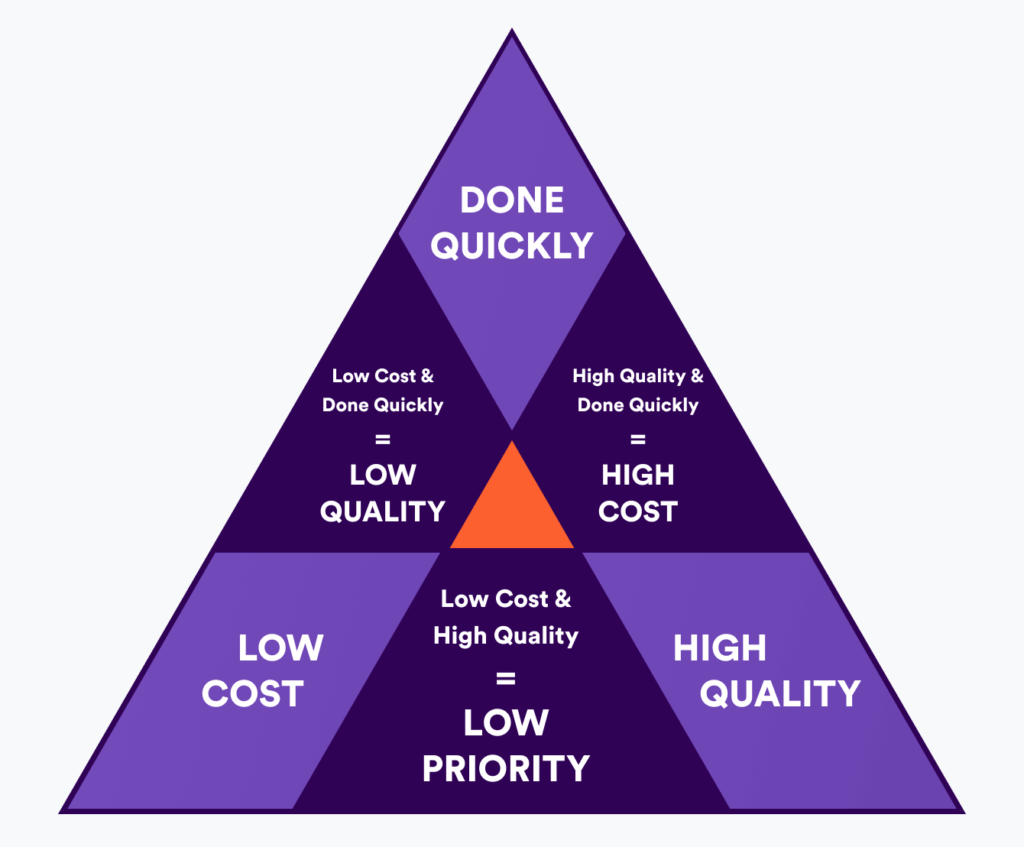
To better understand what we mean, imagine that you’re at the market and want to buy apples, pears, and apricots. You have only one basket that can hold 2 kg. You can choose only 1 kg of apples and 1 kg of pears. Or you can buy 666 g of each fruit, including apricots. The same applies to development. You can have speed, cost, and quality in balance.
Understand the price in the equilibrium
Now that you know that you don’t need to give up on the quality or speed, you need to understand how they affect software development costs. It’s simple: the faster or more complex the development you choose, the more you’ll need to pay.
Note that we’ve chosen the word “complex” here for a reason. A simple app can be built by a mediocre developer (read: “cheap”). But if you need a more complex solution, an inexperienced developer and sloppy code can cost you the entire project.
The equilibrium of quality, speed, and cost suggests that your sweet spot is not the lowest possible app development price, but a perfect combination of these factors:
- Lower rates compared to a domestic in-house team or a domestic software development agency
- Development experience and expertise
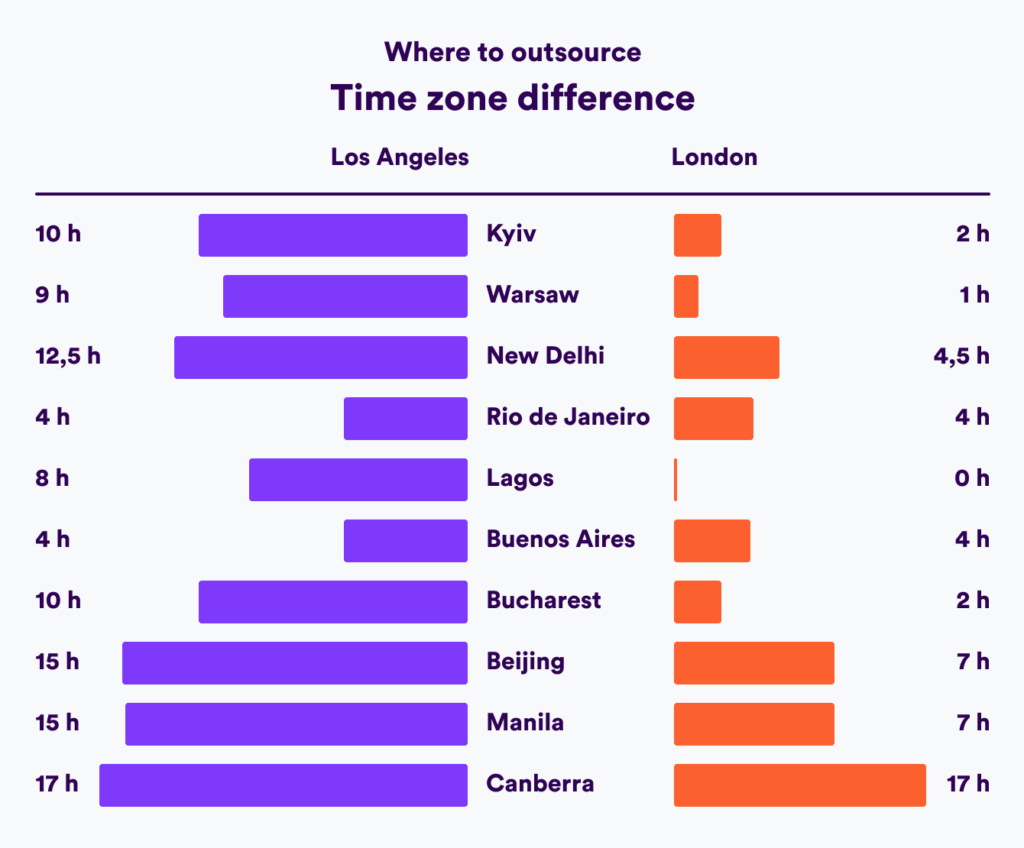
- Professional service level, including English and communication skills
- Low risk of project failure
The combination of these factors is also the reason why software development prices vary.
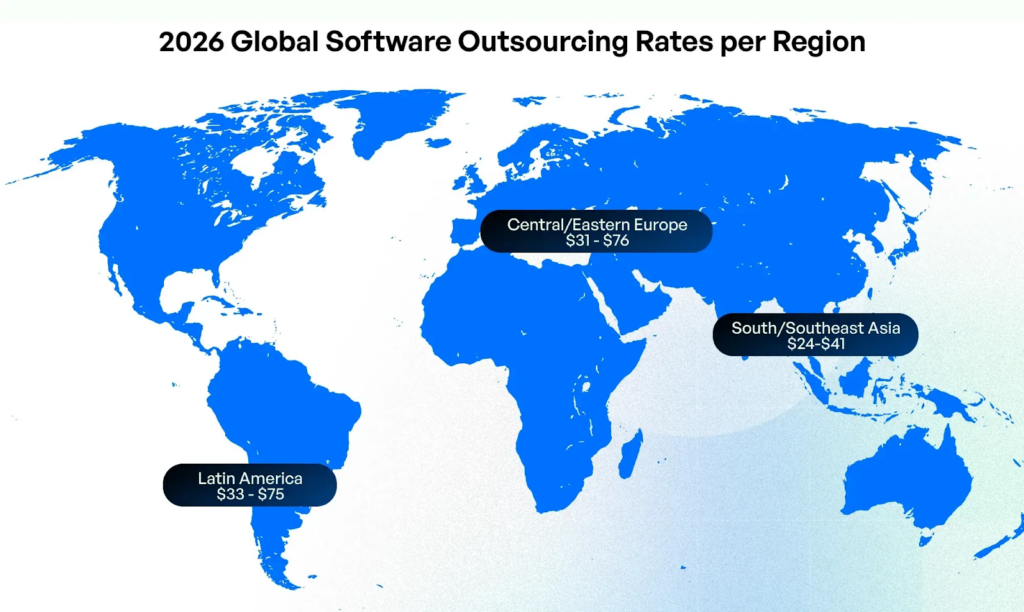
Source: Accelerance
Let’s take a quick look at the two most popular markets for outsourcing.
South/Southeast Asia
Developers from this region charge comparatively low rates, meaning that on average, a developer will cost you only $24-$41 per hour. Mind that these rates can vary based on the specific city, experience level, and technology stack. However, you can end up with low-quality and slow development.
Indian developers follow a long list of religious and state holidays. Additionally, Asian culture differs from Western culture, and you will likely need to micromanage the team. Asian developers may lack initiative and avoid confrontation, leading to less honest feedback than you expect.
Central/Eastern Europe
The average cost to develop an app in Central and Eastern Europe, on the other hand, is typically lower than in the USA. A mid-level developer will charge you between $31 and $76 per hour. However, the quality and speed of development are on par with Western standards.
Eastern European countries like Ukraine are flooded with experienced developers known for their responsibility and diligence. What makes the software development price go down in this case? In short, this happens due to the following:
- Competition
- Team remoteness
- Culture difference
The last two factors don’t directly affect the overall development speed (read: cost). Yet how vendors and customers interpret information during remote meetings depends on their cultural and regional backgrounds. Compared to Asia, cultural differences are much more subtle.
While the russian invasion caused an enormous shock to the previously booming IT industry before March 2022, by the middle of 2026, the sector had fully recovered. Local firms reacted to the stress of the russian attack by going remote, providing backup batteries and charging stations to employees, and offering relocation opportunities for staff. Many businesses continued to operate, talent remained productive, and regional clusters developed into solid local economies that attract skilled labor and investment. Read more about the current state of operations in Ukraine here.

Back to the cultural differences and miscommunication. To avoid such scenarios, project managers on both ends have to set more precise objectives and be ready to make communication a substantial part of the development project.
| Region | Development cost | Development speed | Development quality |
| South Asia
India, Pakistan |
Extremely cheap
~$24-41 per hour |
Low | Usually low |
| Eastern Europe
Ukraine, Poland, Romania |
20-30% cheaper compared to the US
~$31-76 per hour |
Usually high, but there can be communication difficulties | High due to a deep talent pool and alignment with Western standards |
Let’s look at the factors that influence the app cost.
App development cost breakdown
This section will discuss how app development costs are calculated. We’ll run through the main questions you need to ask yourself. Then we’ll explain how the app’s price changes based on your answers.
Spoiler: Be ready to write down formulas.
10 Questions to ask yourself
Here are the three main questions about your future application and its functionality.
| Questions | Example of an Uber-like application |
| 1. Which platforms are you targeting? | Uber has web and mobile applications (both iOS and Android). |
| 2. How many different types of users will use your platform? | Drivers and passengers use the Uber platform. |
| 3. Does the platform need manual administration (human intervention)? | Uber has a team that administers rides and has access to passengers’ confidential information. |
If you need a mobile application, here is one more question to consider:
| Questions | Example |
| 4. Is the app a simple minimum viable product (MVP) or a proof of concept (PoC) whose functionality doesn’t depend on the device’s capabilities? | The functionality of augmented reality or Bluetooth depends on the system on which the app is running(iOS or Android). If it’s not the case, you can use the cross-platform approach and write one codebase for two platforms. |
Now, you need to understand the team structure and the level of control you need over the development process. Here are six more questions to think of:
5. Do you need someone to test the stability of the application you’ve developed?
6. Do you need to design the application’s look and feel (graphic design and user interface)?
7. Do you have a strong brand identity?
8. Have you clearly outlined the main problems and the ways of solving them?
9. Do you have precise algorithms with flowcharts for problem-solving?
10. Do you need a manager who will control the development process and predict, mitigate, and address issues as they arise? This includes risk assessment, goal and objective setting, and identification of weak points.
How do your answers affect the app development price?
The initial development time needed for your project will increase or decrease depending on your answers. Let’s get straight into this.
Number of platforms
| You need to multiply the initial development time by the number of platforms +1 for backend development if you have more than one platform. If you target three platforms (web, iOS, and Android), multiply the initial time by 4. If you have only one web platform or one mobile platform (iOS or Android), the initial time won’t change. | Initial time x (the number of platforms + 1) |
Note that you need to understand the difference between platform development and design, as these processes require different time commitments. We’ll explore this in more detail below.
User types
| Multiply the development time by 1.75 for an additional user type. So, for example, if you want an app like Uber with two user types (drivers and passengers), multiply the development time by 1.75. | Dev time x 1.75 per additional type |
Manual administration
If you need manual administration (deletion, editing, adding, or viewing user data), developers will build an additional portal (admin panel) with restricted access. The admin panel should be developed after the backend system is ready, allowing you to visually control the system and the data stored in the database.
| The development of the admin panel usually takes ~0.2 of the time needed for building the backend system. | Dev time + 0.2 x backend development time |
MVP / POC project
For a simple MVP project that has no dependency on device-specific capabilities (Bluetooth, Accelerometer, DNS Settings, Augmented Reality, etc) and requires both iOS and Android applications, you can take advantage of cross-platform development. Note that it doesn’t cut the total development time by two. Due to differences between Android and iOS, developers will still need to code some elements separately for each platform.
| Cross-platform development will save you ~30% of the total mobile app development cost, since developers can merge iOS and Android projects into a single codebase. | Dev time – 0.3 x mobile development time |
Stability testing
Developers can make mistakes and don’t always consider all possible user scenarios (for example, how the app should act if you receive a call while using it). Neither the client nor the developers can identify all insufficiencies. For this reason, we always recommend having an expert trained to recognize the app’s weak points, improve development quality, and reduce costs when solving issues.
| Testing takes ~0.35 of the time required for front-end development (across web, iOS, and Android). | Dev time + 0.35 x ( front-end development time) |
UX/UI design
Documentation on UX/UI design provides developers with a clear understanding of the app’s interface, element placement, interactions, colors, fonts, and more. You can’t develop an app without its UI and UX design, just like you can’t build a building without architectural planning.
| UX/UI design for a single platform takes half the time required for the front-end development. Note that a platform is either mobile, web, or desktop. Android and iOS will be counted as a single platform due to their similar design approaches. | Dev time + 0.5 x front-end development per platform |
Management and problem-solving
The processes of a software development project are similar to those of a construction project. Just like a construction foreperson controls a construction site, you may need a specialist who will ensure that development tasks are performed correctly and on time.
| Managers spend the time equal to the sum of all person-hours multiplied by ~0.1. To manage an average team of 10 full-time specialists, a full-time manager will be needed. | Dev time + (the sum of all person-hours * 0.1) |
If you feel a bit lost after so many formulas, don’t be. Let’s see how we calculate the app development cost in a real example.
How much does it cost to develop an app? (Calculation example)
Here, we’ll calculate the average cost to build an app for two different projects using the formulas above. The average development time is 2 months (336 hours), so we’ll use this in our calculations.
An app like Uber
Before we start, here are a few things we need to take into account:
- This app will be used by two user types: drivers and passengers.
- The application should be built for iOS and Android to reach more passengers and drivers. This will also ensure that drivers have enough clients, and passengers can always find a driver nearby.
- The application will require manual administration (e.g., driver deletion, client communication, etc.).
- The application development won’t be short, so we’ll need a manager.
- We can’t save money using cross-development because this project isn’t simple. Even Uber has recently migrated its React Native apps to native iOS and Android.
| User type
We have 2 user types, so we need to multiply the development time by the coefficient. |
Initial time x 1.75 per additional type | 336 x 1.75 = 588 |
| Platforms
The app will be built for iOS and Android, so we need to estimate the time required for backend development as well. |
Dev time x (the number of platforms + 1 for backend) | 588 x (2 + 1) = 1,764 |
| Manual administration (admin panel)
Admin panel development takes half of the backend development time. |
Dev time + 0.5 x backend development time | 1,764 + (0.2 x 588) = 1,764 + 118 = 1,882 |
| Testing
To calculate the time needed for testing, we first estimate the time required for front-end development, divide it by 2, and then multiply by the coefficient. |
Front-end development = Total time – backend – admin panel development | 1,882 – 588 – 118 = 1,176 |
| Dev time + 0.35 x (front-end development time) | 1,882 + 0.35 x (1,176) = 1,882 + 412 = 2,294 | |
| UX/UI design
We should treat iOS and Android as a single mobile platform. Since we calculated the time needed for the front-end development for iOS and Android, we need to divide this value by 2 and then apply the formula. |
Dev time + 0.5 x front-end development per platform | 2,294 + 0.5 x (1,176 / 2) = 2,294 + 294 = 2,588 |
| Management
To calculate the time required for managers, divide the total development time by 12. |
Dev time + (the sum of all person-hours * 0.1) | 2,588 + (2,588 * 0.1) = 2,588 + 259 = 2,847 |
The total development time for the domestic market is 2,847 hours.
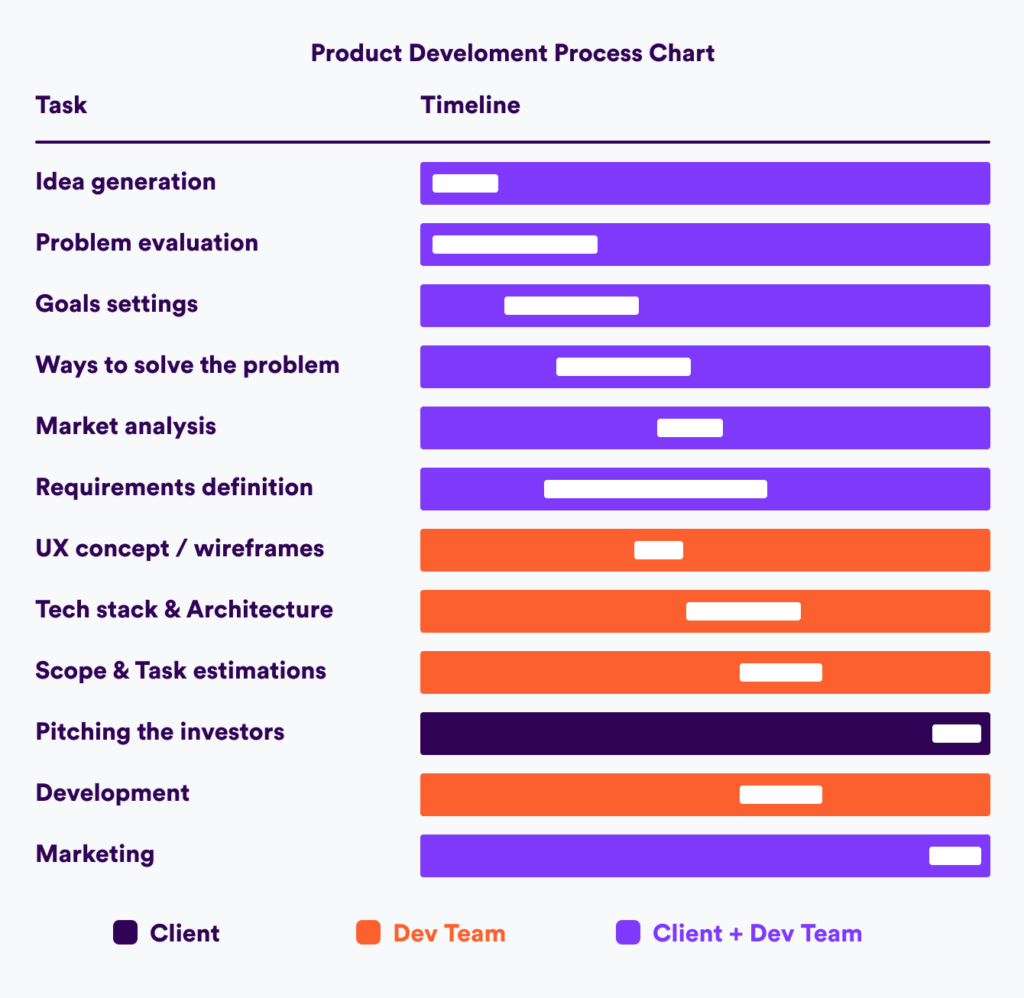
Note that the total time we’ve calculated is not the project timeline, and many processes will be performed in parallel, as shown in this chart. Also, not all roles will cost the same amount. Project management, testing, and design may cost less per hour than development. It is even fair to say that testing = 0.6 * development, design = management = 0.9 * development.
If your domestic market is the USA or the UK, then here is how the speed and cost of making an app will change if you outsource development from India or Eastern Europe:
| Market | Average rate | Average speed | Your project duration and cost |
| Domestic market (USA, UK) | ~$80 per hour | 1x | 2,588 hours
$207,040 |
| Eastern Europe | ~$35 per hour | 1.2x | 3,105 hours
$108,675 |
| India | ~$20 per hour | 2x | 5,176 hours
$103,520 |
A fitness app
This project is much easier than the first one. Developers can build the app on one platform (for example, iOS to start) since app users don’t depend on each other. You also won’t need to invest in backend and admin panel development for the same reason.
If we use the same formulas as in the example, we’ll get around 684 hours for a project. This includes the time needed for a designer, a manager, and a specialist responsible for stability testing.
Here’s how the fitness app development cost will vary across markets.
| Market | Average rate | Average speed | Your project duration and cost |
| Domestic market (USA, UK) | ~$80 per hour | 1x | 684 hours
$54,720 |
| Eastern Europe | ~$35 per hour | 1.2x | 820 hours
$28,700 |
| India | ~$20 per hour | 2x | 1,368 hours
$27,360 |
You’re one step closer to a realistic estimate. Now we’ll cover additional factors that impact the app cost. Depending on the project scope and team size, you may need a different software development pricing model. You can request a fixed price, pay on a time-and-material basis, or go with a dedicated team of developers.
Here are other factors that you need to keep in mind when planning the app price budget:
Maintenance
App maintenance depends on your plans, and its cost can vary significantly for each app.
- Fixing minor issues occasionally and collecting data for the next version requires around 2 hours per week.
- Collecting user feedback and turning it into reality may require up to 16 hours per week, which is full-fledged development rather than maintenance.
We recommend allocating 8 hours per week to maintenance so developers can focus on the project without distractions.
Niche specialization
For artificial intelligence and blockchain technologies, you’ll need developers with proper specialization and experience. Usually, it’s harder to find such specialists, and their hourly rates are 20-30% higher, which will impact the overall application development costs.
SEO
Though SEO may seem irrelevant to web development services at first glance, there is a catch. For SEO tasks, you’ll need an SEO specialist who can run an audit and help you find what to improve. And the developers will need to apply SEO recommendations to the software they are working on.
A simple example: landing speed is crucial from the SEO perspective, but SEO can’t improve the landing speed. Developers will need to use special tools to maximize the performance: server-side rendering (SSR) or a static site generator (SSG). The use of these and other tools can affect the web development cost.
Store publishing
Before publishing your app on the App Store or Google Play, you’ll need to receive approval from these platforms, and this process can increase mobile app development costs. Though receiving approval doesn’t take as long as development, it still takes time. You need to upload the app for review and wait for the reply, which usually takes two days. Then, developers need to tweak the app according to the platform’s feedback and upload it again. This process is repeated several times until the app is finally approved.
Apps with integrated payment systems, betting or casino apps, and apps that collect user data will take longer to verify, and you will also need to provide more documentation. Also, note that both App Store and Google Play charge app developers an account fee ($99 and $25, respectively).
Security and compliance
Security and compliance really come down to a handful of things: threat modeling, encryption, secure authentication (SSO or MFA), solid audit logs, and strict data retention policies. And let’s not forget, if you’re working in industries that deal with GDPR, HIPAA, or PCI DSS, you have to play by those rules too. The moment a team starts processing payments or handling sensitive info, it’s obvious they’ll need compliance experts, and yes, that means budgeting for them right from the start.
Third-party services and API fees
Every feature, including maps, email and SMS, analytics, push notifications, KYC/AML checks, payment gateways, chat or video, and even CAPTCHA, comes with usage fees and takes real work to integrate. Don’t forget about vendor lock-in or the headache (and cost) of switching providers later.
Localization and accessibility
Localization and accessibility present unique challenges for businesses operating in international, highly regulated markets, due to factors such as language support, currency exchange, multiple time zones, right-to-left layouts, and WCAG compliance. As a result, the amount of engineering time spent on design and testing/validation will dramatically increase the development cost.
Wrapping up
Estimating app development costs can be daunting, but it is worth the effort. Understanding your priorities and the factors that affect the final cost will help you discuss the price with your development provider more effectively.
In this post, we’ve calculated the average cost to develop an app. If you want an exact quote, contact us! At NERDZ LAB, we offer full-scale development services for both established businesses and startups. Whatever your needs, we know how to get your app running at a fair price.

Get more insights:
See all